






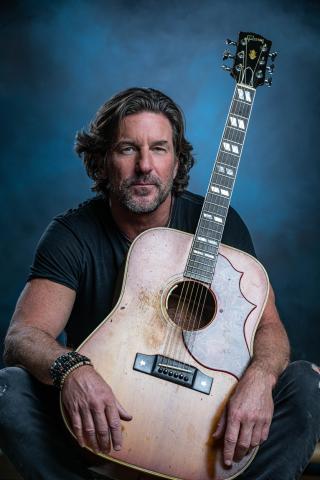
This interview was just recorded 13 days ago, and tragically, Brett James is now no longer with us, following a plane crash six days ago – exactly one week after he participated for this episode. He was a GRAMMY Award-winning singer, songwriter, guitar player, producer, and publisher who had written an astounding 27 number 1 songs. He had more than 800 of his songs recorded by some of the biggest artists in the world, with his songs having appeared on albums with combined sales of over 110 million copies. He was named ASCAP's country songwriter of the year in 2006 and 2010, and Music Row Magazine’s Songwriter of the Year in 2015. He received more than 40 ASCAP hit song awards in country, pop, Latin and Christian genres. In 2020 he was elected to the Nashville Songwriters Hall of Fame. As a producer his credits included Taylor Swift, Jessica Simpson, Danielle Bradberry and Kip Moore. At the time of this interview, he had close to 19 thousand monthly listeners on Spotify, where his top five songs alone had combined for more than six million streams, and his official YouTube channel had over a half-a-million combined video views.
“I always say that my favorite thing about being a songwriter in Nashville for 30 plus years is the friendships you make.”
“That's sort of the challenge of being songwriters. It's … trying to cover new ground, but there's only so many words to rhyme with ‘love.’ And so that becomes a bit of a challenge for all writers is, what are we going to do today that no one has ever heard before?”
“Kind of one of the rules in songwriting sessions is you dare to suck. You can't be afraid to throw out even any idea because somebody else, even if it's not good, somebody might twist it into something that’s great.”
“Once in a while you write a song in a given living room on a Thursday and through the power of kind of radio and the universe and the right singer, the right artist recording that song, it just becomes bigger than all of it… And you write a song that actually means something to people.”
“My third day in Nashville of my spring break, he looked across the desk and he said, ‘Mister, if you move here, I'll give you a record deal.’ And that record deal was like the biggest record deal in Nashville, period, at the time. Like no one, it was like everybody wanted this. And I'd been in Nashville for 72 hours, maybe.”
“I had to take my publisher to breakfast and tell him, ‘Hey, I know I'm your only writer, but I'm going to go back to med school,’ which was an interesting conversation.”
“I had been trying to put myself in kind of a Nashville box for a bunch of years. When you're on Music Row and you're trying to write what everybody else is writing on Music Row at the time, it can get a little confining because you're trying to just fit. You're trying to get that magic little potion, magic little formula. And for me, going back to medical school in Oklahoma and giving up my dream of being a songwriter, of being a successful songwriter or an artist, kind of freed me up.”
“You do the best you can, and you show up the next day and do the best you can and show up the next day and do the best you can. And I always write the best idea I have in the room, I never like, it doesn't matter who I'm writing with, I throw out all my best ideas because I feel like … that's part of the responsibility of doing your very best in every room you can. I don't sit down with the writers who aren't big stars and hold back ideas. I just don't do that.”
“I've been blessed enough to have had I think over 40 songs recorded by a guy named Kenny Chesney, who is one of my dear friends and one of my favorite artists on planet earth.”
“That two weeks of just writing for myself? Probably the most fun I've ever had writing music. Period. Like, I can't even describe how much joy that brought me just sitting literally by myself at my house, just making up stuff. And it was as much fun as I've had in a really long time.”
“Jesus Take the Wheel” (Carrie Underwood)
“When the Sun Goes Down” (Kenny Chesney)