







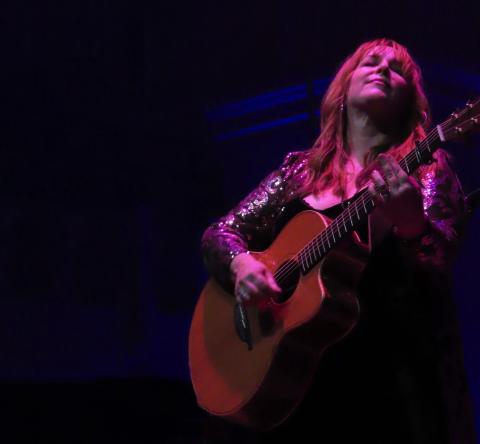
Singer, songwriter, guitar player who has been nominated for two GRAMMY Awards, a Golden Globe, and numerous other awards. Plus, she was inducted into the Nashville Songwriters Hall of Fame in 2014. She has accumulated accolades as a songwriter for artists as diverse as Etta James, Bonnie Raitt, The Neville Brothers, Patty Loveless, George Strait, Bryan Adams and Faith Hill. Her song “Independence Day,” recorded by Martina McBride, won a CMA Song of the Year award in 1995. As an artist, she even performed at Farm Aid in 1996, got radio airplay on the BBC, and performed three times at Glastonbury. She has over 2.2 million combined video views on her official YouTube channel and on Spotify – where she has over 116 thousand monthly listeners – her top five songs alone have gotten over 14.3 million streams on that platform alone.
“When I got finished writing it, I honestly thought, well, no one is ever going to record this except possibly maybe me. And the very first artist that heard it was Martina McBride. And she knew that it was something she wanted to record, and she was adamant about it.”
“I am not by nature much of a co-writer. I've never been comfortable with co-writing particularly.”
“As a songwriter, I tend to be very drawn to stories about people who are somewhat powerless in their situation or trying to find their way out.”
“I tell my songwriting students that the title and the opening line of your song are kind of like the front door of a house, the porch on the front door of a house. It's kind of at that point you decide, well, do I want to go in or not? So, make them intriguing and make them interesting.”
“As a kid growing up in New York, I really wasn't exposed to country music. I didn't even really know about it. It wasn't until much later that I sort of discovered it. But at their heart, they both share a lot of the same things. They share a simplicity of melody. They are both very story oriented. A lot of the lyrics are story songs. They’re both sort of folk music in the sense that they are, it's music that people at home can make.”
“Imitation is, I believe, the way that I learned not only to sing songs and play them, but just to write them. Just understanding how a song is built comes from imitating it, seeing what the parts are and I think I learned quite a lot of that through osmosis just by playing these folks songs over and over.”
“My guitar probably saved my life at that point because I was pretty miserable for a couple of years and spent a lot of a lot of time in my room with my guitar, which, I'm not sure I would have this career had I not had those hours of wood shedding.”
“One of the things that I had to get my head around was that there was this sort of song factory. There was a job description called songwriter where you could literally go and sit in a room with somebody usually it was a co-writer during the morning and write a song and then go and sit in the room with somebody else that afternoon write another song and never go on the road and never make a record and you could have a lovely career that way.”
“One of the things people don't realize is that really great publishers, they know what makes writers tick. They understand and they observe, and they enable them to do their own thing. They enable them to be who they are going to be.”
“I used to say co-writing to me feels like going on a blind date except the kicker is you have to show up naked because songwriting is such a vulnerable sort of naked revealing kind of process.”
“Much like with co-writing I didn't have any success with any of the things that I was sort of attempting to write commercially that I was, you know, I tried to imitate, and nobody cared. Those songs didn't get any interest. And sort of at the same time I would write something that I just needed to get out, really wrote something that I just was writing for me and those were the songs that were getting attention to my complete confusement.”
“Independence Day” (Martina McBride)
“Five Minutes”